"In the long run, there's only so much mileage in these brands persistently directing the public's thoughts towards what is actually, in truth, their products' worst attribute."
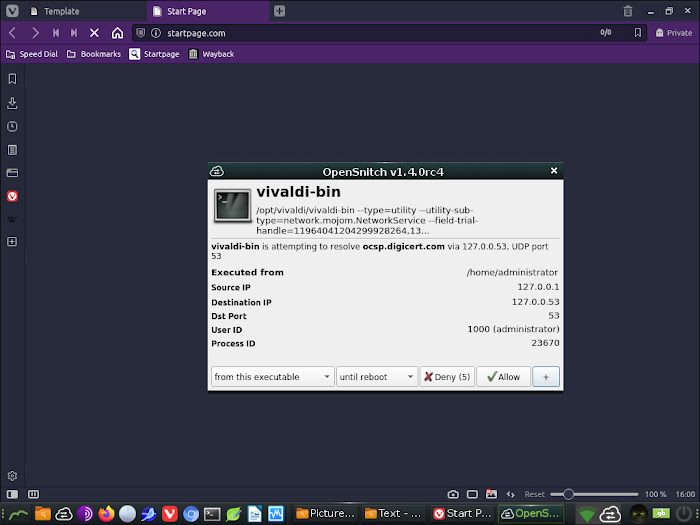
In Bodhi Linux, Vivaldi 4.3 forced direct connections to certificate authority domains before allowing visits to encrypted pages.
The privacy bandwagon is in town, and the cart is pretty crowded as it rounds the corner onto High Street. As each jostling brand throws its surface-scrubbed privacy parcels out to the roadside gathering with gleeful abandon, open hands grab at the shower of generous gifts.
The public broadly accepts cybertech's privacy claims at face value, and this has created a digital Gold Rush, in which all manner of companies wave brightly-decorated incognito masks at Google's userbase, in the hope of enticing a lucrative mass exodus. But when Google's users jump across into this wonderful new world of incognito, it slowly dawns on them that Google has made the jump too - in an incognito mask of its own.
"The Wayforward Machine is shocking only in its monumental hypocrisy and sick, shameless twisting of reality to push Big Tech's agenda of zero accountability."
If you haven't yet seen it, Wayforward Machine is the Internet Archive's latest fun toy.
You hop onto the site, enter your choice of URL, and the software will simulate the exact opposite of the Wayback Machine's renowned function. It will present the Internet Archive's vision not of our digital history, but of our digital future - circa 2046.
Except it's not a fun toy. The Wayforward Machine is a sick and twisted propaganda ploy by the Big Tech collective. We know from the involvement of the "digital rights" groups and usual suspects like Wikipedia and Mozilla, that this is a Big Tech lobby, not a game. And it's a propaganda campaign I predicted in my article Big Tech's Secret Fear: The
Disappearing Web. This is the sqwawk of petulance that proves cybertech is quaking in its boots about losing its unfettered stewardship of other people's content. As a prediction in Wayforward's timeline of doom puts it…
"The big donations are not really donations. They're deals.
And the small donors are just the mugs who pay to be trampled on by the
big donors."
Above the fold on the EDRi (digital rights group) homepage. But it's really about activism, not the money, you understand.
As we head towards a world in which every other Twitter feed harbours a link to GoFundMe or similar, there's an uncomfortable sense that charityhas slowly been hijacked by the rising class of the “champagne victim” or "grassroots activist". The “champagne victim” being a well-off individual or business, using emotional pressure and guilt-building tactics to source charitable donations on their own behalf. The "grassroots activist" being a self-styled champion of human rights, whose real concern for the common people persistently hovers around the nil mark.
It's certainly true to say that in some areas, the sob story has begun to replace the transaction as the go-to means of making money online. And in terms of personal economy, why wouldn't it? I mean, why complete ten online surveys for £8, or write a thousand-word blog post for £20, when you can just slap down your victim card and have some charitable soul give you an unconditional £50? And then another. And then another.
Times have changed. We're now used to reaching the bottom of a lazy, half-soaked blog article, only to be told we should be paying for the four minutes we've just wasted reading other people's random, speculative quotes from Twitter. Four minutes we will never get back.
What so many of us don't realise, is that the people tapping us up for these donations are so often getting paid anyway. Some of them have strings of major corporate sponsors. Some of them receive very hefty grants. They may sell their best content from behind a paywall. Why pay them for the clickbait they know no one will buy?…
[UPDATE: I've since built an app to create content pods and other distributable writing formats totally offline. You can find out more and get the download links in Take The Web Offline With Lit.OTG.
I've left the original post below.
The Original Post...
"An HTML web page can be incredibly simple, and
it can be created entirely offline with something like Seamonkey
Composer. I'll move onto that shortly. In fact, I'll summarise the
whole creation process."
A portable, offline version of the NRGCult post "I am Suing the Feminist Metal-Bending Channel".
Content creators… Imagine producing a website or blog without the involvement of any remote service. Imagine completing the whole process on your local drive, without any signups, without any terms, and without any conditions. Imagine being able to send your DIY website, or collection of web pages, directly to people of your choice. By email. Or on CDs, or on DVDs.
Content consumers… Imagine being able to read content in total privacy. Imagine that content being delivered to you in a format that doesn't allow your interests to be profiled. Imagine that content being futureproof and immune to censorship. Imagine being the gatekeeper of that content, so you don't have to rely on a bunch of massive tech companies graciously allowing you to find and/or access it.If these ideals appeal to you, then let me welcome you to the world of portable content.
Portable content is not attached to any specific web service. You choose how you want to deliver or receive it. It's extremely difficult for Big Tech to censor, suppress or ban, and it's totally impossible to interfere with when it's distributed on disc media at functions or in other offline situations.
"This is what the broad tech industry wants. Products that are useless for 99% of people. Because if the firewall works properly, the tech industry doesn't get its saleable data."
A good, communicative firewall at work. This is Opensnitch reporting Systemd Timesync's attempt to contact ubuntu.com in Bodhi Linux. This is one of the network connections made without user consent or knowledge in Ubuntu-derived Linux operating systems. You can argue that the connection is in this case harmless or useful, but it's nevertheless an instance of the computer making its own networking decisions, on the quiet. The user's awareness should never be bypassed in this way. Without a good firewall, who's in control?
It amazed me, about eighteen months back when I first began my shift from Windows into the world of Linux, that so many in the Linux community said firewalls were unnecessary. It amazed me that so many Linux distributions came with the firewall deactivated. It amazed me that the most common Linux default firewalls are uncooperative command-line routines. It wasn't, so it turned out, that there were no good options. It was that the package managers were choosing not to include one.
I've loved the improvements in quality of digital life that Linux has brought me. For the first time in many years I've felt that being 100% in control of my computers is within reach. But the firewall situation struck me as odd. Here was a breed of operating system that traded on improved privacy and delivered generally good transparency as compared with the ironically ever-opaque Windows. And yet Linux rarely came ready to run with the most basic privacy protector of all - a firewall that any home user could control. Was this a conspiracy?
There's only one reason why we're implored or forced to keep software "up to date", and it's not "security". It's so the tech industry has an instant push system for each new Big Brother powerplay as it's released. "Up to date" has never been a real necessity. It's a manufactured necessity. A brainwash.
Remember a time before browsers blocked important pages? The more updates you accept, the more freedom you lose...
"Unsupported browser - access denied!"… "Your security is at risk - access denied!"… "Your TLS version is out of date - access denied!"… "Your system is too slow - access denied!"… "Certificate invalid - access denied!"… "Page data cannot be authenticated - access denied!"… "Your connection is unsafe - access denied!"… "Your device has exhibited unusual behaviour - access denied!"… "This site cannot verify that you are human - access denied!"…
Do you ever get the feeling that someone's throwing obstacles at your attempts to use the internet?
That's because they are. The inexhaustive range of artificial barriers I've cobbled together above illustrate just how much our agency to freely roam the internet is waning. More and more, we're finding that software and hardware needs the approval of powerful data companies in order to function properly in cyberspace. Among other things, that means we can no longer use the technology we want to use. We have to use what we're told to use.
And the end game? Our submission to 24/7 surveillance. If a piece of technology doesn't afford tech powers the means to spy on us, it gets blocked from the internet. Most often, the block is not the decision of individual websites. It's a collusion between the browser providers and a range of immensely powerful tech corporations who have appointed themselves as the Internet Police. A besuited, shiny-shoed middle-mafia has formed between you and the sites you seek to visit. And if either you or the sites ain't playin' ball with the whims of Big Tech, more now than ever, it's access denied.
Beneath the hard wall of blocked access, there's then a wider-reaching soft wall. A wall in which search engines - the tools we use to source relevant content - are algorithmically pushing us towards the "right kind of content", and away from the "wrong kind of content". Anyone who thinks I'm chasing some wack conspiracy theory should check this…
"Corporate spying, at the level it's now reached, is creepy, stalkerish, manipulative, predatory, warped, perverted, and abusive of human rights. Even if it carries no demonstrable collateral harm, you don't need to feel it's something you should willingly and happily accept."
The easy way to write a post about online privacy would be to list a range of so-called “privacy respecting” alternatives to Big Tech. But it's become increasingly obvious that at least some of these alternatives are a far cry from what they claim to be, and are actually part of the very system they profess to oppose.
At best, simply trusting services because their marketing says “we're all about your privacy”, when some of the worst privacy policies in the world open with “Your privacy is important to us”, is a wildly superficial and somewhat naïve approach.
The true key to optimising online privacy lies in disrupting the core tenets of tracking. Tenets as simple as product allegiance, for example. By sticking with one brand, one browser, one login, we make ourselves frightfully easy to monitor. Whilst, say, a VPN is touted as a route to better privacy, it allows a single provider to log the entirety of a user's online activity. And there's nothing other than that provider's word to say that the available information will not be packaged and sold to the Great Inscrutables.